Japanese Ceramide Skincare: The Research Western Brands Don't Translate
By Dr. Aiko Tanaka · Tokyo Cosmetic Chemist & Senior Editor, J-Beauty Decoded
Updated May 2026- Kao (花王) discovered ceramide's role in skin barrier function in 1985 while researching dishwashing detergent-induced hand damage, and launched Curel — the world's first ceramide-functional skincare line — in 1999 (花王 キュレルの歩み, 2025)

Quick Answer
- Kao (花王) discovered ceramide's role in skin barrier function in 1985 while researching dishwashing detergent-induced hand damage, and launched Curel — the world's first ceramide-functional skincare line — in 1999 (花王 キュレルの歩み, 2025)
- Human skin contains over 300 distinct ceramide molecular species classified into 12 structural types, each with different barrier and moisture functions (日本生化学会誌, 2017)
- Kao's 2025 study published in the Journal of Cosmetic Dermatology found that sensitive skin shows characteristic changes in ceramide profiles that correlate with disrupted lamellar structures and increased irritation susceptibility (花王プレスリリース, 2025)
- The Tokyo Metropolitan Institute of Medical Science identified PNPLA1 as the long-sought acylceramide synthesis enzyme, explaining why certain genetic conditions cause catastrophic barrier failure (東京都医学総合研究所, 2017)
Why Japanese Ceramide Research Matters More Than You Think
Photo by jarmoluk on Pixabay
Here's the thing about ceramides in Western skincare: brands throw the word around like a magic spell. "Contains ceramides!" Great. Which ones? At what ratio? Based on what research?
Japanese researchers have been studying ceramides for 40 years. Not as a marketing ingredient — as a core dermatological science. The depth of Japanese ceramide research is staggering, and almost none of it has been translated into English or incorporated into Western skincare formulations.
This article translates the key findings from Japanese ceramide research that change how you should think about barrier repair, sensitive skin treatment, and moisturizer selection.
The 12 Types of Ceramides: A Classification System the West Ignores
Western skincare typically mentions "ceramides" as a single category, maybe distinguishing between "ceramide NP" and "ceramide AP" on an ingredient list. Japanese dermatology recognizes 12 distinct structural classes of ceramides, each defined by its sphingoid base and fatty acid combination.
The classification system, standardized in Japanese dermatological literature, works like this:
Sphingoid Base Types
Ceramides are built from a sphingoid base linked to a fatty acid. The four sphingoid bases found in human skin are:
- S (Sphingosine / スフィンゴシン): The most common base type
- P (Phytosphingosine / フィトスフィンゴシン): Contains an extra hydroxyl group
- H (6-Hydroxysphingosine / 6-ヒドロキシスフィンゴシン): Contains a hydroxyl at the 6-position
- dS (Dihydrosphingosine / ジヒドロスフィンゴシン): Lacks the double bond found in sphingosine
Fatty Acid Types
Each sphingoid base can be linked to one of three fatty acid types:
- N (Non-hydroxy fatty acid / ノンヒドロキシ脂肪酸): Standard fatty acid chain
- A (Alpha-hydroxy fatty acid / α-ヒドロキシ脂肪酸): Hydroxyl group at the alpha position
- EO (Ester-linked omega-hydroxy fatty acid / エステル結合ω-ヒドロキシ脂肪酸): Long-chain fatty acid with an omega-linked linoleic acid ester
The 12 Classes
Combining 4 sphingoid bases × 3 fatty acid types = 12 ceramide classes:
| New Nomenclature | Old Name | % in Stratum Corneum | Primary Function |
|---|---|---|---|
| CER[NS] | Ceramide 2 | ~22% | Most abundant; core moisture retention |
| CER[NP] | Ceramide 3 | ~13% | Smoothing; wrinkle prevention |
| CER[AS] | Ceramide 5 | ~10% | Barrier structural support |
| CER[NH] | Ceramide 7 | ~8% | Antibacterial barrier function |
| CER[AP] | Ceramide 6 | ~4% | Turnover promotion; texture improvement |
| CER[AH] | Ceramide 8 | ~4% | Anti-inflammatory support |
| CER[NdS] | Ceramide 2 variant | Variable | Water-holding capacity |
| CER[EOS] | Ceramide 1 | ~7% | Critical lamellar structure anchor |
| CER[EOP] | Ceramide 9 | ~5% | Lamellar structure stabilization |
| CER[EOH] | Ceramide 4 | ~3% | Deep barrier integrity |
| CER[AdS] | — | Trace | Research stage |
| CER[EOdS] | — | Trace | Research stage |
Why this matters for product selection: When a Western brand says it contains "ceramides," it typically means CER[NP] (Ceramide 3) and maybe CER[AP] (Ceramide 6). But the most critical ceramide for barrier function — CER[EOS] (Ceramide 1) — is almost never included because it's expensive and difficult to stabilize in formulations.
Japanese brands like Curel and CeraLabo have invested heavily in replicating the natural ceramide ratio, not just including individual ceramides for label claims.
Kao's 40-Year Ceramide Research Journey
No company on earth has invested more in ceramide skincare research than Kao Corporation (花王). Their story is worth understanding because it explains why Japanese ceramide products are fundamentally different from Western ones.
1976: The Beginning
Kao established its "Skin Research Laboratory" (皮膚研究室) to study why dishwashing detergent caused chronic hand dermatitis in homemakers. This wasn't a cosmetics initiative — it was a product safety investigation.
1985: The Ceramide Discovery
Kao researchers identified that detergent exposure depleted intercellular lipids in the stratum corneum, with ceramides being the most critical component lost. They confirmed that ceramides function as the "mortar" between "brick-like" corneocytes, and that ceramide depletion directly causes barrier dysfunction, moisture loss, and irritant susceptibility.
This was published in Japanese dermatological journals and presented at the Japanese Society for Investigative Dermatology (日本研究皮膚科学会). At the time, Western dermatology was still focused primarily on humectants (glycerin, urea) and occlusives (petrolatum) for dry skin.
1987: Ceramide-Functional Ingredient Development
Kao developed what they called "セラミド機能成分" (ceramide-functional ingredient) — a synthetic ceramide analog that mimics the barrier-repair function of natural ceramides without the stability and cost issues of using actual human-identical ceramides.
This ingredient, cetyl-PG hydroxyethyl palmitamide, became the cornerstone of the Curel brand. It's not technically a ceramide — it's a pseudo-ceramide that functions like one. This distinction matters because it's why Curel can be affordable and stable at drugstore prices while delivering genuine barrier repair.
1999: Curel Launch
Curel (キュレル) launched as the world's first skincare brand specifically designed for "乾燥性敏感肌" (dry-sensitive skin), built entirely around Kao's ceramide-functional technology.
The branding was bold: Kao invented a market category that didn't formally exist. "Dry-sensitive skin" wasn't a recognized dermatological term in Japan at the time. Kao had to educate both dermatologists and consumers simultaneously.
It worked. By 2025, Curel holds the #1 market share in Japan's sensitive skin skincare category (東洋経済, 2025). The brand has expanded to over 20 countries.
2025: The Sensitive Skin Ceramide Profile Study
In April 2025, Kao published groundbreaking research in the Journal of Cosmetic Dermatology, in collaboration with Teikyo University of Science. The key findings:
- Sensitive skin shows a distinctly different ceramide profile compared to non-sensitive skin — it's not just "less ceramide" but a different ratio of ceramide subtypes
- The altered profile correlates with disrupted lamellar structures (the organized lipid layers between skin cells)
- Specific ceramide imbalances predict irritation susceptibility — meaning you could theoretically test someone's ceramide profile and predict how sensitive their skin will become
This research suggests that effective sensitive skin treatment needs to restore the correct ceramide ratio, not just add ceramide volume. Most Western ceramide products add a single type at a high concentration. The Japanese approach is moving toward multi-ceramide formulations that match the natural profile.
The PNPLA1 Discovery: Why Some People Can't Make Ceramides
In 2017, researchers at the Tokyo Metropolitan Institute of Medical Science (東京都医学総合研究所) made a major discovery. Led by Research Director Murakami Makoto (村上誠), the team identified that the enzyme PNPLA1 is the long-sought acylceramide synthase — the enzyme responsible for producing acylceramides (CER[EOS], CER[EOP], CER[EOH]) in the skin.
Why This Matters
Acylceramides are the ceramide subtypes that anchor the lamellar structure of the stratum corneum. Without them, the barrier collapses. The team demonstrated this by comparing PNPLA1-deficient mice with normal mice using comprehensive lipidomics analysis:
- PNPLA1-deficient mice completely lacked acylceramides
- Their skin barriers were catastrophically impaired — massive transepidermal water loss, extreme sensitivity to irritants
- The skin condition resembled ichthyosis (a severe genetic skin disorder in humans)
This discovery explains the molecular basis of several genetic skin conditions and opens the door to targeted therapies that could restore acylceramide production. It was published in Japanese biochemistry journals (生化学, 2017) and has since been cited extensively in international dermatology research.
Implications for Skincare
If your skin has reduced PNPLA1 activity (which can be influenced by genetics, age, and environmental factors), topical ceramide products that include acylceramide analogs could be particularly beneficial. Currently, only a handful of Japanese cosmetic companies are formulating with acylceramide-type ingredients — this is still frontier territory.
Ceramide vs. Hyaluronic Acid: The Japanese Perspective
Source: Japanese Taste
Japanese skincare science draws a clear distinction between these two moisturizing approaches that Western marketing tends to blur:
Hyaluronic Acid (ヒアルロン酸)
- Mechanism: Humectant — attracts and holds water
- Location: Primarily acts on the skin surface and upper stratum corneum
- Best for: Immediate hydration, plumping, dehydrated skin
- Limitation: Does not repair barrier function; effects are temporary without occlusives
Products like Hada Labo Gokujyun Premium excel at delivering maximum hydration through multiple molecular weights of HA.
Ceramides (セラミド)
- Mechanism: Barrier repair — restores intercellular lipid structure
- Location: Integrates into the stratum corneum's lamellar layers
- Best for: Barrier-damaged skin, chronic dryness, sensitivity, eczema-prone skin
- Limitation: Takes longer to show visible results; effects are structural rather than immediate
The Japanese Approach: Use Both
Japanese dermatologists (as referenced in multiple articles on the Seki Dermatology Clinic website, 富山市セキひふ科クリニック) typically recommend:
- Hyaluronic acid lotion to provide immediate hydration
- Ceramide-containing cream or serum to repair and maintain barrier integrity
- Occlusive layer (vaseline, squalane, or rich cream) to seal everything in
This layered approach addresses both the symptom (dryness) and the cause (barrier damage) simultaneously. It's the fundamental logic behind the multi-step Japanese skincare routine — not arbitrary product multiplication, but strategic layering of different moisturizing mechanisms.
Our Routine Builder tool can help you combine ceramide and hyaluronic acid products in the right order for your skin concerns.
Japanese Ceramide Products Worth Knowing About
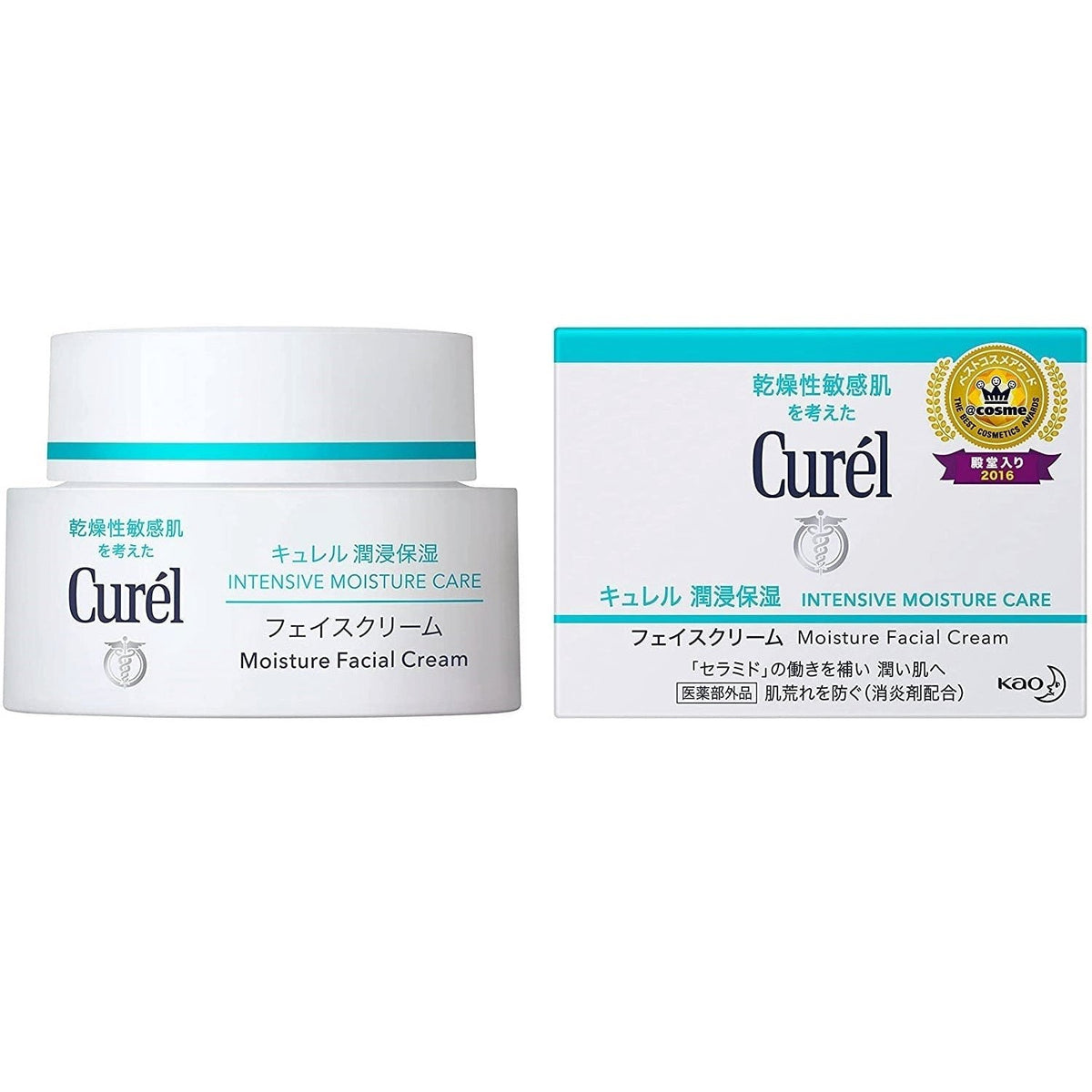
Curel Intensive Moisture Cream (キュレル 潤浸保湿フェイスクリーム)
The gold standard. Contains Kao's proprietary pseudo-ceramide (cetyl-PG hydroxyethyl palmitamide) plus eucalyptus extract. Fragrance-free, alcohol-free, hypoallergenic. ¥2,530 for 40g.
2026 update: Kao launched the "角層深部バリア美容液" (Deep Stratum Corneum Barrier Serum) in March 2026 as the most advanced Curel product yet, using new technology to deliver ceramide-functional ingredients deeper into the stratum corneum (花王プレスリリース, 2025).
Matsuyama Hadauru Moisturizing Infusion (松山油脂 肌をうるおす保湿浸透水)
Contains 5 types of human-type ceramides (CER[NP], CER[AP], CER[NS], CER[EOP], CER[NG]). This is one of the few Japanese drugstore products that includes acylceramide-type CER[EOP]. ¥1,540 for 120ml.
CeraLabo Moisturizing Lotion (セラキュア モイスチャライジングローション)
Formulated by cosmetic chemist Kazunosuke (かずのすけ), a Japanese beauty science educator with a PhD in cosmetic chemistry. Contains 5 human-type ceramides at intentionally optimized ratios. More expensive than drugstore options (¥3,500 for 150ml) but formulated with genuine research rigor.
Kose Bioliss Veganee Ceramide Treatment
Contains rice-derived ceramides (コメヌカスフィンゴ糖脂質) — plant-sourced ceramides that are structurally similar to human ceramides. ¥1,100 for 480ml. Japanese researchers at multiple universities have studied rice ceramides as a cost-effective alternative to synthetic human-type ceramides.
The "Cacao Ceramide" Discovery: Emerging Japanese Research
In January 2024, Teikyo University professor Koga (古賀教授) published joint research with Meiji Corporation (the chocolate maker) discovering that previously unused parts of cacao beans contain a novel ceramide — "カカオセラミド" (cacao ceramide) — with moisturizing properties (帝京大学プレスリリース, 2024).
This research is early-stage but notable because:
- It demonstrates Japan's approach of finding ceramide sources in unexpected places (rice, cacao, konjac)
- It represents a potential new sustainable source of plant-derived ceramides for cosmetic use
- It's a collaboration between a university and a food company, which is typical of how Japanese ceramide research crosses industry boundaries
What This Means for Your Skincare Choices
If You Have Sensitive Skin
Look for products with pseudo-ceramide or multi-type ceramide formulations rather than single-ceramide products. Kao's 2025 research shows that sensitive skin has a disrupted ceramide ratio, not just a ceramide deficiency. Products like Curel that address the functional barrier (not just the ingredient label) are more likely to help.
If You Have Dry but Not Sensitive Skin
A combination of hyaluronic acid for hydration and ceramides for barrier repair will give you the best results. The Japanese layering approach — HA lotion → ceramide serum/cream → occlusive — addresses dehydration and barrier weakness simultaneously.
If You're Choosing Between Western and Japanese Ceramide Products
Japanese ceramide formulations tend to:
- Include multiple ceramide types (not just NP and AP)
- Use pseudo-ceramides engineered for stability and skin compatibility
- Be formulated based on clinical research on Japanese (Asian) skin, which has thinner stratum corneum and different baseline ceramide profiles than Caucasian skin
- Be more affordable — Curel's moisturizer costs ¥2,530 vs. Dr. Jart+ Ceramidin Cream at ¥4,000+ or Elizabeth Arden's ceramide capsules at $50+
You can use our Ingredient Decoder to check whether a product contains human-type ceramides or cheaper alternatives.
The Lamellar Structure: Why Ceramide Arrangement Matters More Than Quantity
Western ceramide products focus on ceramide concentration — "contains 3% ceramides" or "ceramide-rich formula." Japanese research focuses on something more fundamental: the arrangement of ceramides within the skin's lipid layers.
What Is Lamellar Structure?
The stratum corneum (角層) — your skin's outermost layer — is organized in a "brick and mortar" pattern:
- Bricks = corneocytes (dead skin cells)
- Mortar = intercellular lipids (ceramides, cholesterol, free fatty acids)
The "mortar" isn't just randomly distributed lipids. It's organized into precise lamellar structures — stacked, parallel lipid bilayers with alternating water-rich and lipid-rich layers. This structure is what makes skin simultaneously waterproof from the outside and moisture-retaining from the inside.
The Japanese Research Advantage
Kao's Skincare Research Center (花王スキンケア研究所) has pioneered the use of small-angle X-ray scattering (SAXS) and electron microscopy to visualize lamellar structures in living human skin. Their findings, published across multiple Japanese dermatology journals:
- Healthy skin shows well-organized, regularly spaced lamellar layers with consistent periodicity (~13nm long periodicity and ~6nm short periodicity)
- Sensitive/dry skin shows disrupted lamellar structures with irregular spacing, gaps, and disorganized lipid arrangement
- The specific ceramide ratio determines lamellar quality — adding more ceramide doesn't help if it's the wrong type or ratio
This is the insight that Western ceramide products largely miss. You can dump a high concentration of CER[NP] into a product and label it "ceramide-rich," but if the ratio to cholesterol and free fatty acids is wrong, it won't form proper lamellar structures on the skin.
The Optimal Ratio
Japanese research (published in the Journal of the Japanese Cosmetic Science Society, 日本香粧品学会誌, 2021) suggests that effective ceramide products should approximate the natural ratio of intercellular lipids:
- Ceramides: ~50% of intercellular lipids
- Cholesterol: ~25%
- Free fatty acids: ~15%
- Other lipids: ~10%
This 50:25:15 ratio is what Japanese formulators target. Products that include only ceramides without cholesterol and fatty acids are working against the skin's natural architecture.
Ceramide Depletion: What Causes It and Who's Most Affected
Photo by jarmoluk on Pixabay
Age-Related Decline
Japanese longitudinal studies show ceramide levels decrease approximately 30% between ages 20 and 50 (花王スキンケアナビ, 2025). The decline isn't uniform across all ceramide types:
- CER[EOS] (acylceramide) shows the most dramatic decline — critical because it's the primary anchor of lamellar structure
- CER[NP] and CER[NS] decline moderately
- CER[AP] shows relatively stable levels with age
This differential decline means that aging skin doesn't just need "more ceramides" — it specifically needs more acylceramide-type lipids. Most anti-aging ceramide products don't address this specificity.
Environmental Factors
Japanese research has identified several environmental factors that accelerate ceramide depletion:
- Over-cleansing: Excessive use of surfactant-based cleansers strips intercellular lipids. This is why the Japanese double cleanse debate is so relevant to ceramide health
- Low humidity: Japan's dry winter air (particularly in heated indoor environments) accelerates transepidermal water loss and ceramide degradation
- UV exposure: Chronic UV exposure disrupts ceramide synthesis pathways in the epidermis
- Detergent exposure: Kao's original 1985 research showed that surfactant exposure depletes ceramides — relevant for anyone who frequently washes hands or uses cleaning products
Genetic Factors
The PNPLA1 research from the Tokyo Metropolitan Institute connects to a broader understanding of genetic variation in ceramide production. Some individuals genetically produce less acylceramide, predisposing them to chronic barrier dysfunction. This is now understood to be a contributing factor in:
- Atopic dermatitis (アトピー性皮膚炎)
- Ichthyosis vulgaris (尋常性魚鱗癬)
- Chronic dry skin unresponsive to standard moisturizers
Japanese dermatologists increasingly test ceramide profiles in patients with refractory dry skin conditions, using lipidomics techniques developed at institutions like Kao's research center and the Tokyo Metropolitan Institute.
Oral Ceramides: The Japanese Supplement Approach
Japan has a robust market for "beauty from within" (インナービューティー) supplements, and oral ceramides are a significant category.
The Research Base
Multiple Japanese clinical studies have examined oral ceramide supplementation:
- A 2017 study published by Oryza Oil & Fat Chemical Company showed that oral rice-derived glucosylceramide (0.6mg/day for 12 weeks) significantly increased skin hydration and reduced transepidermal water loss compared to placebo
- Konjac-derived ceramide supplements (こんにゃくセラミド) are particularly popular in Japan, with several studies showing improvements in skin moisture levels after 4-8 weeks of supplementation
- Pineapple-derived ceramide (パイナップルセラミド) has emerged as a newer ingredient in Japanese beauty supplements
How Oral Ceramides Work
The mechanism, as explained in Japanese pharmacological research:
- Ingested ceramides are broken down in the gut into sphingoid bases and fatty acids
- These components are absorbed into the bloodstream
- They reach the skin via circulation
- Skin cells use them as building blocks to synthesize new ceramides locally
The effect is modest compared to topical application — oral ceramides improve skin hydration by approximately 10-20% in clinical studies, while topical ceramide products can improve it by 30-50%. Japanese dermatologists generally recommend oral ceramides as a complement to, not a replacement for, topical ceramide skincare.
Popular Japanese Oral Ceramide Products
- Chocola BB Ceramide (チョコラBB セラミド) by Eisai — ¥2,580 for 40 tablets
- DHC Ceramide — ¥1,350 for 30 days
- Orbis Defensera — a "beauty drink" containing glucosylceramide, designated as a Food with Function Claims (機能性表示食品) by Japan's Consumer Affairs Agency
The "機能性表示食品" designation is important — it means the product has submitted clinical evidence to the Japanese government supporting its claimed benefits. This is a stricter standard than typical supplement marketing.
Rice Ceramides: Japan's Unique Plant-Derived Approach
While Western ceramide skincare relies primarily on synthetic or yeast-derived ceramides, Japan has pioneered the use of rice-derived ceramides (コメ由来セラミド, kome yurai seramido). This is a distinctly Japanese innovation rooted in the country's rice culture.
The Rice Bran Connection
Japanese women have used rice bran (米ぬか, nuka) for skin care for centuries. Sake brewery workers were historically noted for their soft, beautiful hands — an observation attributed to constant contact with fermented rice byproducts.
Modern Japanese researchers have identified the scientific basis: rice bran contains glucosylceramides — sugar-linked ceramide precursors that the skin can enzymatically convert into functional ceramides.
Key Research
Japanese studies on rice ceramides include:
- Oryza Oil & Fat Chemical Company (a leading Japanese rice-derived ingredient manufacturer) has published research showing that rice glucosylceramides improve skin hydration by 28% after 6 weeks of topical application
- Hokkaido University researchers identified that specific rice varieties (particularly Japanese short-grain varieties used in sake brewing) contain higher glucosylceramide concentrations than long-grain varieties
- Kose Corporation uses rice ceramide extracts (コメヌカスフィンゴ糖脂質) in multiple skincare lines, marketed as "和漢植物由来セラミド" (traditional Japanese botanical-derived ceramides)
Rice Ceramides vs. Synthetic Ceramides
| Factor | Rice Ceramides | Synthetic Human-Type |
|---|---|---|
| Structure | Glucosylceramide (needs enzymatic conversion) | Direct ceramide match |
| Cost | Lower | Higher |
| Sustainability | High (byproduct of rice processing) | Moderate |
| Efficacy | Good (requires conversion step) | Direct barrier integration |
| Cultural resonance | Strong in Japan | Neutral |
Japanese consumers often prefer rice-derived ceramides for cultural reasons — the connection to traditional Japanese beauty practices adds perceived value. Scientifically, synthetic human-type ceramides are more directly effective, but rice ceramides offer a compelling combination of efficacy, affordability, and sustainability.
Ceramide Testing: How Japanese Consumers Evaluate Products
Japanese skincare communities have developed practical, at-home methods for evaluating ceramide product effectiveness. These aren't scientific tests, but they provide useful consumer-level feedback.
The "Morning Moisture Check" (朝のうるおいチェック)
Apply the ceramide product at night. In the morning, before washing, press a finger against your cheek. If skin feels:
- もっちり (mochimochi / bouncy): Product is maintaining hydration overnight — good sign
- カサカサ (kasakasa / dry/flaky): Product isn't providing sufficient barrier support
- べたべた (betabeta / greasy/sticky): Product may be too heavy or not absorbing properly
The "2-Week Barrier Test" (2週間バリアテスト)
Japanese beauty bloggers recommend using a ceramide product exclusively (no other active treatments) for 2 weeks while monitoring:
- Does redness decrease?
- Does sensitivity to temperature changes improve?
- Does skin feel less "reactive" to products that previously stung?
- Does makeup apply more smoothly?
Positive changes in these areas indicate the ceramide product is genuinely improving barrier function, not just sitting on the surface.
The "Wind Test" (風テスト)
Stand in front of a fan or in a breezy environment. If your skin immediately feels tight or uncomfortable, your barrier is compromised and you need ceramide support. If you can stand in wind without discomfort, your barrier is healthy.
This simple test is recommended by multiple Japanese dermatology clinics as a quick barrier health assessment.
Frequently Asked Questions
What's the difference between human-type ceramides and pseudo-ceramides?
Human-type ceramides (ヒト型セラミド) are structurally identical to ceramides naturally found in human skin. They integrate directly into the lamellar structure. Pseudo-ceramides (疑似セラミド) are synthetic molecules that mimic ceramide function without being structurally identical. Kao's Curel uses pseudo-ceramides because they're more stable, cheaper to produce, and clinically proven to restore barrier function comparably to human-type ceramides.
How many types of ceramides should a product contain?
Japanese dermatological consensus suggests that products with 3+ types of ceramides — particularly including CER[NP], CER[AP], and ideally CER[EOS] or CER[EOP] — provide more comprehensive barrier repair than single-ceramide products. The natural stratum corneum contains all 12 types, but no topical product currently replicates the full profile.
Do oral ceramide supplements work?
Japanese researchers have studied oral ceramide intake (mainly from rice, konjac, and wheat sources). Several Japanese studies show modest improvements in skin hydration and barrier function from oral ceramide supplements, typically at doses of 0.6-1.8mg/day for 4-12 weeks. However, the effect is significantly smaller than topical application. Japan has an extensive market for "beauty supplements" (美容サプリ) including ceramide capsules, but most dermatologists recommend topical application as the primary approach.
Why doesn't Western skincare use as many ceramide types?
Cost and regulatory complexity. Human-type ceramides are expensive to synthesize, and formulating with 5+ types requires balancing solubility, stability, and skin penetration for each one. Japanese companies like Kao have invested decades of R&D into solving these problems. Western brands have generally taken the simpler approach of using 1-2 types at lower concentrations, often combined with other lipids like cholesterol and fatty acids.
Can ceramides cause breakouts?
Pure ceramides are non-comedogenic, but ceramide products may contain other ingredients (emulsifiers, oils, fatty acids) that can trigger breakouts in acne-prone skin. Japanese ceramide products formulated for sensitive skin (like Curel) tend to be non-comedogenic. Always patch test, and look for "ノンコメドジェニックテスト済み" (non-comedogenic tested) on Japanese product packaging.
The Cholesterol and Fatty Acid Partners: Why Ceramides Don't Work Alone
One of the most important and overlooked insights from Japanese ceramide research is that ceramides function as part of a lipid trio, not as a solo ingredient.
The Intercellular Lipid Trio
The stratum corneum's barrier is built from three classes of lipids working together:
- Ceramides (~50%): Provide the structural backbone of lamellar layers
- Cholesterol (~25%): Fills gaps between ceramide molecules and provides fluidity
- Free fatty acids (~15%): Primarily palmitic and stearic acid; contribute to barrier integrity and pH maintenance
Why Ratio Matters
Japanese researchers at Kao and other institutions have demonstrated through X-ray diffraction studies that:
- Ceramides alone form rigid, poorly organized structures
- Ceramides + cholesterol form better-organized layers but with gaps
- Ceramides + cholesterol + fatty acids form the optimal lamellar structure that mimics healthy skin
This is why the best Japanese ceramide products include all three components. Curel's formula includes cholesterol derivatives and fatty acid esters alongside its pseudo-ceramide. Matsuyama's Hadauru line includes squalane and plant-derived fatty acids. CeraLabo explicitly formulates to the natural ratio.
Product Label Check
When evaluating a ceramide product, look for these companion ingredients:
- Cholesterol (コレステロール) — direct cholesterol supplementation
- Phytosterols (フィトステロール) — plant-derived cholesterol analogs
- Stearic acid (ステアリン酸) — the most abundant free fatty acid in healthy skin
- Palmitic acid (パルミチン酸) — the second most abundant skin fatty acid
- Squalane (スクワラン) — provides lipid supplementation and occlusion
A product listing ceramides WITHOUT any of these partners may be less effective than one with lower ceramide concentration but a balanced lipid profile. This is one of the biggest differences between Japanese and Western ceramide formulation philosophy.
Related Reading
- Hada Labo Gokujyun Premium: Why 15 Million Japanese Women Use This One Moisturizer
- The 2025 @cosme Best Sunscreen Awards: Every Winner Translated and Ranked
- Anessa vs. Biore vs. Skin Aqua: Japan's Top 3 Sunscreens Compared
— The J-Beauty Decoded Team