Japanese Makeup Removers: The Cleansing Balms and Oils @cosme Loves
By Dr. Aiko Tanaka · Tokyo Cosmetic Chemist & Senior Editor, J-Beauty Decoded
Updated May 2026- Japan's makeup remover market generated ¥128.7 billion ($858 million) in 2024, with cleansing oils and balms overtaking traditional micellar water as the dominant format — oil-based removers now account for 52% of the category (富士経済, 2024)
Quick Answer
- Japan's makeup remover market generated ¥128.7 billion ($858 million) in 2024, with cleansing oils and balms overtaking traditional micellar water as the dominant format — oil-based removers now account for 52% of the category (富士経済, 2024)
- Fancl Mild Cleansing Oil holds the all-time @cosme Best Cosmetics Award with 11,400+ reviews and has been the bestselling cleansing oil in Japan for 16 consecutive years, moving 6.5 million bottles annually (ファンケル決算, 2024)
- Japanese cleansing balms use a "乳化" (emulsification) mechanism that transforms oil into a milky emulsion with water, lifting makeup and sunscreen completely without requiring harsh surfactants
- The Japanese approach treats makeup removal as skincare, not as a utilitarian step — @cosme has 8 separate subcategories for removers including cleansing oil, cleansing balm, cleansing cream, cleansing milk, cleansing water, cleansing gel, point remover, and cleansing sheets
Why Japanese Makeup Removal Is Skincare, Not a Chore
Source: Japanese Taste
In the West, makeup removal is step zero. Get it off, move on. Micellar water on a cotton pad, maybe a wipe if you're lazy. The product barely matters.
Japan disagrees. Profoundly.
Japanese skincare philosophy treats クレンジング (cleansing) as the most important step in the entire routine. Not moisturizer. Not serum. Cleansing. The logic: no matter how good your skincare is, it can't penetrate if your pores are clogged with sunscreen residue, sebum, and particulate matter from the day.
This belief shows up in @cosme's data. The cleansing category has more reviews than any other skincare category except moisturizer. And the review detail is extraordinary — Japanese users evaluate texture during application, emulsification speed, rinse-off feel, post-cleanse moisture level, and compatibility with specific sunscreens.
For the full Japanese cleansing approach — first cleanse (makeup removal) plus second cleanse (face wash) — see our Japanese double cleanse method guide.
The Three Formats: Oil, Balm, and Cream
Cleansing Oils (クレンジングオイル)
The original Japanese format. Shu Uemura introduced the concept of cleansing oil in 1967, and Japan has dominated the category ever since. Cleansing oils are liquid at room temperature, dispensed from a pump bottle, and emulsify when mixed with water.
Best for: Waterproof sunscreen removal, heavy makeup, speed (fastest format) Market share in Japan: 34% of all makeup removers (インテージ SRI+, 2024)
Cleansing Balms (クレンジングバーム)
Solid at room temperature, they melt into oil on contact with skin. Balms have surged in popularity since 2020 — the format grew 23% year-over-year in 2024 (富士経済, 2024). The solid format appeals to Japanese consumers who prefer a more tactile, massage-like experience.
Best for: Dry skin, massage-style cleansing, pore care, travel (no spill risk) Market share in Japan: 18% and growing rapidly
Cleansing Creams (クレンジングクリーム)
The gentlest format. Creams don't strip sebum as aggressively as oils, making them preferred by dermatologists for sensitive and dry skin types. They're slower — requiring more massage time to dissolve makeup — but leave skin feeling the most comfortable post-cleanse.
Best for: Sensitive skin, dry skin, minimal makeup days Market share in Japan: 12%
@cosme's Top Cleansing Oils
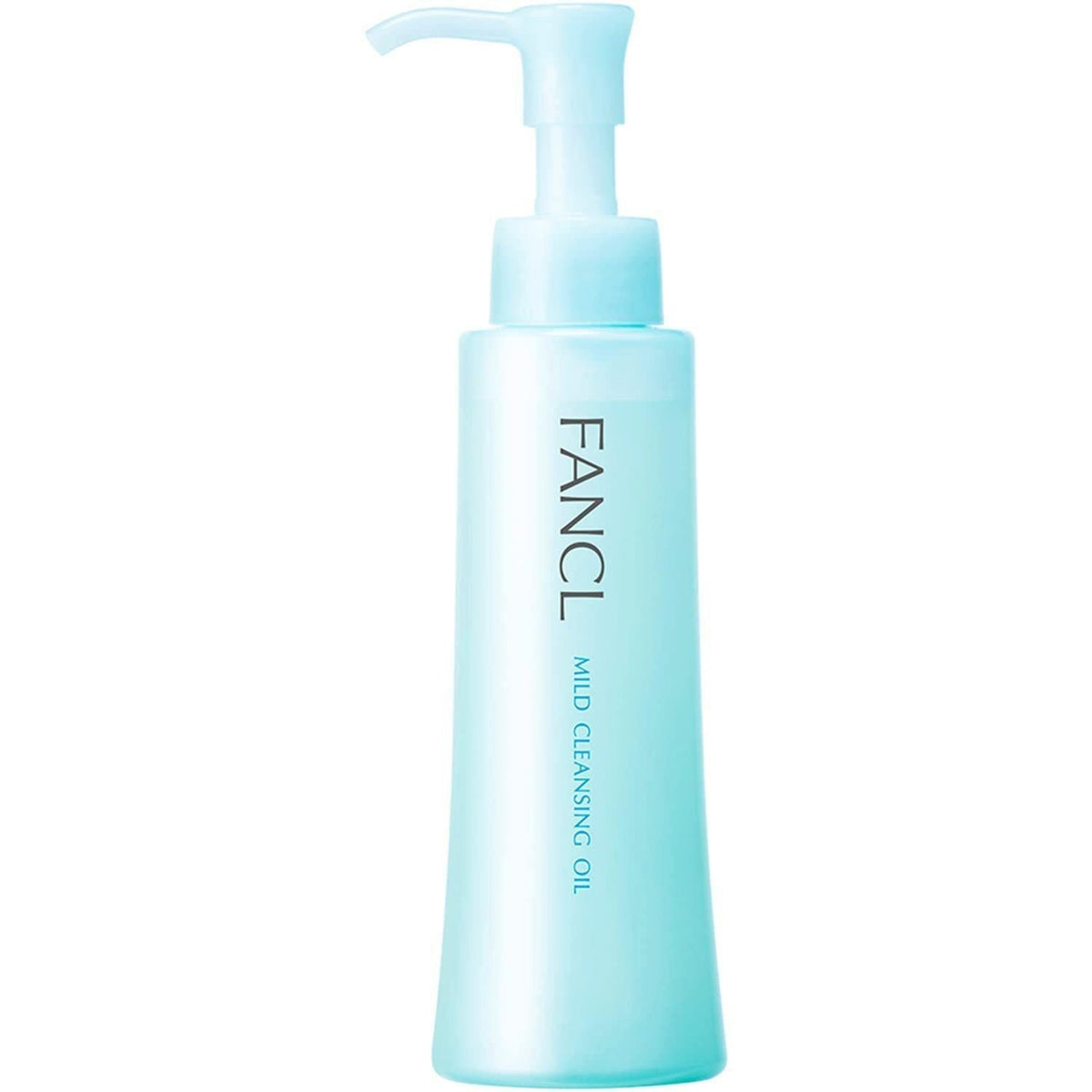
1. Fancl Mild Cleansing Oil (ファンケル マイルドクレンジング オイル)
Brand: Fancl (ファンケル) Price: ¥1,870 for 120ml ($12.50) @cosme reviews: 11,400+ Rating: 5.1/7.0
Fancl's cleansing oil has been Japan's #1 seller for 16 years running. The formula is preservative-free (防腐剤無添加), fragrance-free, and formulated with what Fancl calls "とろすべオイル" — an oil that feels thick going on but emulsifies instantly.
The Fancl philosophy: Fancl was founded in 1980 with the mission of eliminating preservatives from cosmetics. Their cleansing oil reflects this — it ships in small bottles with short expiry dates, designed to be used within 60 days of opening. Japanese consumers accept this inconvenience because they trust the formulation integrity.
How it works: The oil dissolves sebum plugs (角栓) in pores while emulsifying makeup. @cosme reviewers frequently show before-and-after photos of the "角栓が取れた" (sebum plugs came out) effect — visible white plugs extracted during the cleansing massage.
What reviewers say: A 30-something user: "I've used this for seven years. When I switched to another oil for a month, my pores got worse immediately. Nothing emulsifies as cleanly as Fancl." The loyalty reviews — users who've repurchased 10, 20, even 50+ bottles — are a category unto themselves.
2. Shu Uemura Ultime8∞ Sublime Beauty Cleansing Oil (シュウ ウエムラ アルティム8∞ スブリム ビューティ クレンジング オイル)
Brand: Shu Uemura (シュウ ウエムラ) Price: ¥5,720 for 150ml / ¥12,650 for 450ml ($38.10 / $84.30) @cosme reviews: 8,200+ Rating: 5.5/7.0 Key ingredients: 8 botanical oils including Japanese camellia oil (椿油)
Shu Uemura invented the cleansing oil category. The Ultime8 is their premium offering — a blend of eight plant oils formulated to function as both makeup remover and skin treatment simultaneously.
The star ingredient is Japanese camellia oil (椿油), a traditional Japanese beauty oil used for centuries. Camellia oil's oleic acid composition closely matches human sebum, making it exceptionally compatible with skin.
Price context: At ¥5,720 for 150ml, this is a luxury product. But Japanese consumers who buy the 450ml refill bring the per-ml cost to ¥28 ($0.19/ml) — comparable to many mid-range cleansing oils. The refill culture in Japan significantly reduces the effective cost of premium products.
3. Attenir Skin Clear Cleanse Oil (アテニア スキンクリア クレンズ オイル)
Brand: Attenir (アテニア) — Fancl Group Price: ¥1,870 for 175ml ($12.50) @cosme reviews: 6,300+ Key ingredients: 5 botanical oils, rock rose oil (ロックローズオイル)
Attenir is Fancl's sister brand, and this cleansing oil represents the best value in Japan's premium cleansing oil segment. At ¥1,870 for 175ml — more product than Fancl's own cleansing oil at the same price — Attenir offers a botanical oil blend that targets "肌ステイン" (skin stain), their term for oxidized residue that dulls skin over time.
Insider knowledge: Japanese beauty forums frequently recommend Attenir as "ファンケルと同じグループで安い" (same group as Fancl but cheaper). The formulation quality is comparable, with a slightly more aromatic experience from the citrus fragrance blend.
@cosme's Top Cleansing Balms
Photo by MarcodaModa on Pixabay
1. DUO The Cleansing Balm (DUO ザ クレンジングバーム)
Brand: Premier Anti-Aging (プレミアアンチエイジング) Price: ¥3,960 for 90g ($26.40) @cosme reviews: 7,500+ Rating: 5.0/7.0
DUO is the brand that made cleansing balms mainstream in Japan. Their original balm — sold in a distinctive red jar — created the category's explosion after launching in 2010. DUO reports cumulative sales exceeding 40 million units (プレミアアンチエイジング IR, 2024).
The balm uses "毛穴クリアカプセル" (pore-clear capsules) — tiny encapsulated beads that burst during massage to release cleansing agents directly into pores. The texture transition is immediate: solid → oil → milky emulsion in about 60 seconds of massaging.
The product line expansion: DUO now offers 5 variants — Black (pore care), White (brightening), Clear (sensitive), Green (barrier repair), and Violet (aging). Japanese consumers frequently own multiple variants and rotate based on skin condition.
2. Banila Co Clean It Zero (バニラコ クリーン イット ゼロ)
Brand: Banila Co (Korean, sold in Japan) Price: ¥2,640 for 100ml ($17.60) @cosme reviews: 3,800+
A Korean import that's earned a permanent @cosme ranking. Banila Co's sherbet-textured balm dissolves faster than most Japanese competitors, and the ¥2,640 price point undercuts DUO significantly. Japanese reviewers compare the two products extensively — DUO wins on skincare benefits, Banila Co wins on speed and value.
3. Lululun Cleansing Balm (ルルルン クレンジングバーム)
Brand: Lululun (ルルルン) Price: ¥2,420 for 90g ($16.10) @cosme reviews: 2,100+
From the sheet mask brand covered in our upcoming sheet mask showdown, Lululun's cleansing balm uses rice-derived ingredients — a signature of Japanese formulation. The 生コメヌカ油 (raw rice bran oil) base connects to the fermented rice tradition in Japanese skincare explored in our fermented ingredients guide.
@cosme's Top Cleansing Creams
Pond's Cold Cream (ポンズ コールドクリーム)
Brand: Unilever Japan Price: ¥825 for 270g ($5.50) @cosme reviews: 3,600+
Pond's Cold Cream has been sold in Japan since the 1950s and maintains a devoted following. The "コールドクリーム" (cold cream) format — thick, white, and massaged off with tissue before rinsing — is considered old-fashioned by younger consumers but beloved by users over 40 who prioritize gentle cleansing.
At ¥825 for 270g, the value is extraordinary. Japanese skincare forums call it "おばあちゃんの知恵" (grandmother's wisdom) — a product so old-fashioned it circles back to being smart.
The Emulsification Test: How Japanese Consumers Evaluate Cleansing
Japanese consumers have a specific evaluation framework for makeup removers that doesn't exist in Western beauty culture: the 乳化テスト (emulsification test).
Here's how it works:
- Apply cleansing oil or balm to dry face
- Massage for 30-60 seconds to dissolve makeup
- Add a small amount of water to hands
- Massage again — the product should turn milky white (乳化)
- Rinse off — no residue should remain
If a product doesn't emulsify cleanly, @cosme reviewers penalize it harshly. "乳化しにくい" (hard to emulsify) is one of the most common negative descriptors in cleansing oil reviews.
Why it matters: Proper emulsification means the oil has fully combined with water and will rinse completely. Products that don't emulsify well leave an oily film that interferes with subsequent skincare absorption — a critical failure in the context of multi-step Japanese routines.
Japanese Sunscreen and Cleansing: The Critical Connection
Photo by pmvchamara on Pixabay
Japan produces the world's most advanced sunscreens — waterproof, sweatproof, and designed to survive humidity. The flip side: they're engineered to stay on your skin. This creates a specific demand for cleansing products that can break through these formulations.
@cosme reviews frequently mention specific sunscreen compatibility:
- Anessa Perfect UV: Requires oil-based cleanser — micellar water won't fully remove it
- Biore UV Aqua Rich: Water-based formula that's easier to remove, but the protective film still needs proper cleansing
- Skin Aqua UV Super Moisture Gel: Relatively easy to remove, but @cosme users still recommend oil cleansing for complete removal
See our Anessa vs Biore vs Skin Aqua comparison for details on each sunscreen's formulation and removal difficulty.
The Japanese rule: If a product claims ウォータープルーフ (waterproof), use an oil-based cleanser. No exceptions.
Point Makeup Removers: The Overlooked Category
Japan has a robust subcategory of ポイントメイクリムーバー (point makeup removers) — products specifically designed for eye and lip makeup.
Bifesta Eye Makeup Remover (ビフェスタ アイメイクアップリムーバー)
Brand: Mandom (マンダム) Price: ¥770 for 145ml ($5.10) @cosme reviews: 5,200+
A biphasic (oil + water layer) remover that you shake before use. Japanese consumers consider it essential for removing waterproof mascara — a near-universal product in Japan — without rubbing the delicate eye area.
Heroine Make Speedy Mascara Remover (ヒロインメイク スピーディーマスカラリムーバー)
Brand: Isehan (伊勢半) Price: ¥924 ($6.20) @cosme reviews: 6,800+
Applied directly to mascara-coated lashes before your regular cleansing step, this pre-treatment dissolves even the most stubborn waterproof mascaras. Japan's mascara products are notoriously resilient — Heroine Make's own mascaras are famous for being nearly impossible to remove — and this remover was designed specifically to counter their own products.
How to Choose: Decision Framework
| Your Situation | Best Format | Top Pick | Price |
|---|---|---|---|
| Heavy makeup + waterproof sunscreen | Cleansing oil | Fancl Mild Cleansing Oil | ¥1,870 ($12.50) |
| Daily makeup, enjoys massage routine | Cleansing balm | DUO The Cleansing Balm | ¥3,960 ($26.40) |
| Sensitive/dry skin, light makeup | Cleansing cream | Pond's Cold Cream | ¥825 ($5.50) |
| Budget-conscious, effective removal | Cleansing oil | Attenir Skin Clear | ¥1,870 ($12.50) |
| Luxury experience + treatment | Cleansing oil | Shu Uemura Ultime8 | ¥5,720 ($38.10) |
| Eye makeup specifically | Point remover | Bifesta Eye Makeup Remover | ¥770 ($5.10) |
Frequently Asked Questions
Do I need a separate makeup remover if I already double cleanse? In the Japanese system, the makeup remover IS the first cleanse. Double cleansing means: (1) oil/balm/cream cleanser to dissolve makeup and sunscreen, then (2) water-based face wash to clean skin. You can't skip step one — water-based cleansers alone won't dissolve waterproof products. See our Japanese double cleanse guide for the full technique.
Why are Japanese cleansing oils better than Western ones? Japan has over 55 years of cleansing oil formulation experience — Shu Uemura pioneered the category in 1967. The emulsification technology is more refined, meaning Japanese oils rinse cleaner. Western cleansing oils often leave a residual film that Japanese formulations have engineered out through superior surfactant blends and oil selection.
Can cleansing balms clog pores? Quality Japanese cleansing balms are specifically formulated to be non-comedogenic. Products like DUO and Lululun's balms are designed for pore care — they dissolve sebum plugs during massage. However, cheap balms with heavy mineral oil bases can cause issues. @cosme reviews are the best filter — products with thousands of positive reviews from oily-skin users are safe bets.
How long should I massage a cleansing balm or oil? @cosme consensus: 60-90 seconds on dry skin, then 30 seconds of emulsification with water. Over-massaging (3+ minutes) can strip beneficial oils. Under-massaging (less than 30 seconds) won't fully dissolve waterproof products. Japanese beauty educators recommend setting a timer until the 60-second massage becomes habit.
Are Japanese makeup removers safe for eyelash extensions? Some are specifically formulated for it. Look for "マツエクOK" (eyelash extension OK) on the packaging. Fancl Mild Cleansing Oil and many oil-based removers are NOT compatible with extensions because they dissolve the adhesive. Gel and water-based removers are safer for extensions — check @cosme reviews filtered by "まつエク" for real-user experience with extensions.
Related Reading
- Japanese Double Cleanse Method: What @cosme Data Shows — the full two-step cleansing technique
- Anessa vs Biore vs Skin Aqua Comparison — understanding the sunscreens you need to remove
- Japanese Fermented Skincare Ingredients — the rice-based ingredients appearing in cleansing products
— The J-Beauty Decoded Team