Tranexamic Acid in Japanese Skincare: The Brightening Ingredient You Haven't Heard Of
By Dr. Aiko Tanaka · Tokyo Cosmetic Chemist & Senior Editor, J-Beauty Decoded
Updated May 2026- Tranexamic acid was approved by Japan's Ministry of Health, Labour and Welfare (厚生労働省) as a skin-brightening ingredient in 2002, making it one of the few ingredients with government-backed efficacy claims for melanin inhibition in Japanese cosmetics
Quick Answer
- Tranexamic acid was approved by Japan's Ministry of Health, Labour and Welfare (厚生労働省) as a skin-brightening ingredient in 2002, making it one of the few ingredients with government-backed efficacy claims for melanin inhibition in Japanese cosmetics
- A clinical study of 561 patients showed approximately 90% experienced visible improvement in melasma (肝斑) within 2 months of oral tranexamic acid treatment at 500-1500mg daily (日本皮膚科学会, clinical data)
- Shiseido developed m-tranexamic acid (m-トラネキサム酸), a modified delivery form with enhanced skin penetration, and built proprietary formulation technology that delivers it deeper and faster than conventional tranexamic acid preparations
- Japanese dermatologists routinely prescribe oral tranexamic acid as a first-line melasma treatment — a practice that's only beginning to gain traction in Western dermatology, despite decades of clinical evidence from Japanese and Korean research
What Is Tranexamic Acid?
Source: Japanese Taste
Tranexamic acid (トラネキサム酸) is a synthetic amino acid that most of the world knows as a blood-clotting medication. It's been used in hospitals since the 1960s to control excessive bleeding during surgery, heavy menstrual periods, and trauma.
Its journey into skincare started by accident — and it started in Japan.
In the late 1970s, a Japanese dermatologist noticed that patients taking oral tranexamic acid for bleeding conditions also experienced lightening of their melasma — the brown, patchy pigmentation that appears primarily on the cheeks and forehead. This observation launched decades of research that would eventually establish tranexamic acid as one of Japan's most important brightening ingredients.
The progression went like this:
- 1979: First clinical observations of melasma improvement in patients taking oral tranexamic acid (日本の皮膚科臨床観察)
- 1995: Approved by 厚生労働省 as a skin-soothing ingredient (肌荒れ防止) in quasi-drugs
- 2002: Approved as a brightening/whitening active ingredient (美白有効成分) in quasi-drugs
- 2020s: Now one of the most widely used brightening ingredients in Japanese skincare, available in everything from ¥500 drugstore toners to ¥15,000 prestige serums
For context on where tranexamic acid products fit in a Japanese skincare routine, see our complete guide to Japanese skincare layering order.
How Tranexamic Acid Works: The Science
Understanding tranexamic acid requires understanding why skin darkens in the first place.
The Melanin Production Pathway
When UV light hits your skin, it triggers a cascade:
- UV exposure → keratinocytes (skin cells) release signals including prostaglandins and plasmin
- Plasmin activates melanocytes (pigment-producing cells)
- Activated melanocytes produce more melanin via the enzyme tyrosinase
- Excess melanin gets deposited in the surrounding skin, creating dark spots
Most brightening ingredients target step 3 — they inhibit tyrosinase directly. Vitamin C, arbutin, and kojic acid all work this way. They're effective, but they're fighting the battle at a late stage.
Where Tranexamic Acid Intervenes
Tranexamic acid works at step 2 — earlier in the cascade.
As an anti-plasmin agent (抗プラスミン作用), tranexamic acid blocks plasmin from activating melanocytes in the first place. It's like cutting the signal wire before the alarm goes off, rather than trying to muffle the alarm after it's already ringing.
Specifically:
- Anti-plasmin action → prevents excessive plasmin from reaching melanocytes
- Prostaglandin suppression → reduces the inflammatory signals that amplify melanin production
- Tyrosinase inhibition → indirect suppression of the melanin-producing enzyme via prostaglandin pathway
This multi-level mechanism is why tranexamic acid is particularly effective for melasma (肝斑) — a condition driven by chronic inflammation and hormonal triggers rather than simple UV exposure. Melasma doesn't respond well to conventional tyrosinase inhibitors alone because the problem isn't just excess melanin production; it's an overactive signaling pathway that keeps telling melanocytes to produce more.
Clinical Evidence from Japanese Research
The clinical data supporting tranexamic acid in skincare is substantial:
Oral administration studies:
- A study of 561 patients with melasma showed approximately 90% reported improvement within 2 months of daily oral tranexamic acid at doses of 500-1500mg (日本皮膚科学会データ)
- Daiichi Sankyo Healthcare's clinical trials for their Transino II (トランシーノII) product demonstrated that 8 weeks of oral tranexamic acid produced significant improvement in approximately 85% of participants
- The standard Japanese dermatological protocol is 750mg-1500mg daily in divided doses for 8-12 weeks
Topical application studies:
- Shiseido research demonstrated that 2% tranexamic acid solution applied to guinea pig dorsal skin produced statistically significant suppression of UV-induced pigmentation compared to vehicle alone
- A human trial of 30 women with facial pigmentation using tranexamic acid serum twice daily for 3 months showed measurable reduction in melanin index (資生堂研究データ)
- Shiseido's newer formulation technology demonstrated faster and greater penetration of m-tranexamic acid compared to conventional formulations (資生堂プレスリリース)
Tranexamic Acid in Japanese Skincare Products
The Two Regulatory Pathways
In Japan, tranexamic acid appears in skincare through two distinct channels:
1. 医薬部外品 (Quasi-drugs) — Government-approved active ingredient Products classified as quasi-drugs can list tranexamic acid as an "active ingredient" (有効成分) and make specific claims about brightening or spot prevention. These products have submitted efficacy data to the government.
2. 化粧品 (Cosmetics) — Non-active ingredient Products classified as cosmetics can include tranexamic acid but cannot make specific efficacy claims. It functions as a "skin-conditioning ingredient" in these formulations.
The practical difference: when you see トラネキサム酸 listed under 有効成分 on a Japanese product, you know it's been tested and approved for the claims on the label.
Key Products by Category
Toners (化粧水) with Tranexamic Acid
Shiseido AQUA LABEL White Care Lotion (アクアレーベル ホワイトケア ローション)
- Price: ~¥1,760 / 200ml
- Classification: 医薬部外品
- Active ingredients: m-tranexamic acid
- Shiseido's drugstore-accessible tranexamic acid toner. Uses the proprietary m-tranexamic acid form for enhanced penetration.
Kose Moisture Mild White Lotion (モイスチュアマイルド ホワイト ローション)
- Price: ~¥935 / 180ml
- Classification: 医薬部外品
- One of the most affordable tranexamic acid toners available in Japanese drugstores.
For how these fit among Japan's top toners overall, see our Japanese toner ranking: @cosme's top 10 for 2025.
Serums (美容液) with Tranexamic Acid
HAKU Melanofocus V (HAKU メラノフォーカスV)
- Price: ~¥11,000 / 45g
- Classification: 医薬部外品
- Active ingredients: 4MSK + m-tranexamic acid (W美白有効成分)
- Shiseido's prestige brightening serum combines two proprietary brightening actives. The 4MSK (4-methoxysalicylic acid potassium salt) inhibits melanin production via a different pathway than tranexamic acid, creating a dual-action approach.
- HAKU has been Japan's #1 brightening serum for over 16 consecutive years by market share.
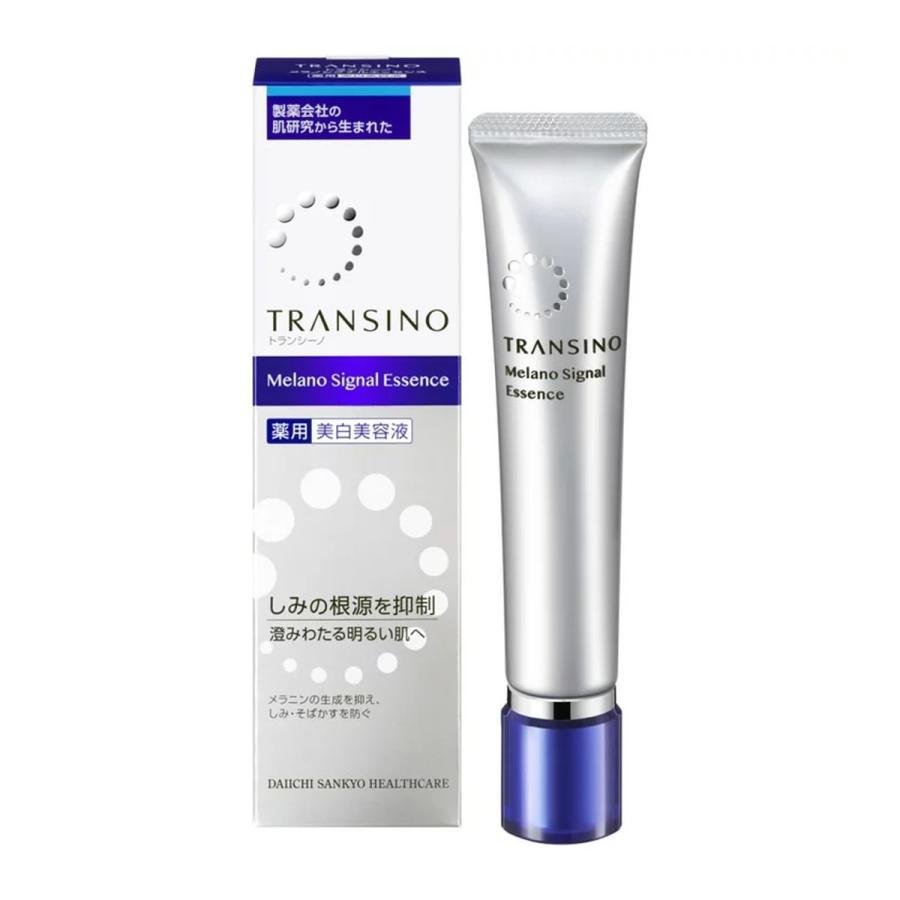
Transino Whitening Essence EX (トランシーノ 薬用ホワイトニングエッセンスEXII)
- Price: ~¥6,380 / 50g
- Classification: 医薬部外品
- Active ingredient: Tranexamic acid
- Made by Daiichi Sankyo Healthcare — the same pharmaceutical company that produces the oral Transino tablets. This gives them a unique credibility in the tranexamic acid space.
Oral Supplements (内服薬)
Transino II (トランシーノII)
- Price: ~¥2,860 / 120 tablets (60 days)
- Classification: 第1類医薬品 (Category 1 OTC drug)
- Dose: 750mg tranexamic acid daily (250mg x 3)
- The standard oral tranexamic acid product in Japan. Available at pharmacies but requires pharmacist consultation (第1類医薬品 can only be sold when a pharmacist is present).
- Recommended cycle: 8 weeks on, then a break before restarting.
Transino White C Clear (トランシーノ ホワイトCクリア)
- Price: ~¥2,860 / 120 tablets
- Classification: 第3類医薬品 (Category 3 OTC drug)
- Contains tranexamic acid + L-cysteine + vitamin C + vitamin B group
- A combination formula for general brightening rather than melasma-specific treatment.
How Japanese Dermatologists Use Tranexamic Acid
Japanese dermatologists (皮膚科医) have a well-established protocol for tranexamic acid that goes beyond what's available over the counter:
Standard Melasma Protocol (肝斑治療プロトコル)
- Oral tranexamic acid — 500-1500mg daily, typically 750mg (250mg x 3 times/day)
- Duration — 8-12 weeks, then reassess
- Combined with — topical vitamin C, sunscreen, and sometimes topical hydroquinone
- Follow-up — If effective, a 4-week break followed by another 8-week course if needed
Advanced Clinical Treatments
Japanese dermatology clinics increasingly combine tranexamic acid with professional treatments:
- Ion introduction (イオン導入) — Using electrical current to drive tranexamic acid deeper into skin than topical application alone
- Mesotherapy / water light injection (水光注射) — Direct injection of tranexamic acid solution into the dermis for localized treatment of stubborn pigmentation
- Combination with laser — Low-power laser toning + oral tranexamic acid for melasma that doesn't respond to topical treatment alone
Dermatologist Recommendations for At-Home Use
Based on recommendations from Japanese dermatology clinic websites (日比谷ヒフ科クリニック, 品川美容外科, 表参道美容皮膚科):
- For prevention: Topical tranexamic acid products (toner + serum) daily, combined with rigorous sunscreen use
- For existing melasma: Oral Transino II for 8 weeks + topical products + daily SPF50+ sunscreen
- For post-inflammatory hyperpigmentation: Topical tranexamic acid is preferred over oral due to the localized nature of the condition
For broader Japanese dermatologist skincare recommendations, see our comprehensive guide to what Japanese dermatologists recommend.
Tranexamic Acid vs Other Japanese Brightening Ingredients
Source: Japanese Taste
Japan has approved multiple brightening ingredients, each with different mechanisms. Here's how tranexamic acid compares:
| Ingredient | Japanese Name | Mechanism | Best For | Approved Year |
|---|---|---|---|---|
| Tranexamic acid | トラネキサム酸 | Anti-plasmin → melanocyte suppression | Melasma, inflammatory pigmentation | 2002 |
| Arbutin | アルブチン | Tyrosinase inhibition | General brightening, sun spots | 1989 |
| Vitamin C (AA-2G) | ビタミンC誘導体 | Tyrosinase inhibition + antioxidant | Acne marks, general brightening | 1991 |
| 4MSK | 4MSK | Tyrosinase activity suppression + melanin discharge | Stubborn spots | 2003 |
| Kojic acid | コウジ酸 | Tyrosinase copper chelation | Post-inflammatory pigmentation | 1988 |
| Linoleic acid S | リノール酸S | Tyrosinase degradation | Established spots | 2001 |
| Chamomile ET | カモミラET | Endothelin suppression | UV-triggered spots | 1999 |
The key advantage of tranexamic acid: it works upstream in the pigmentation cascade. While most brightening ingredients try to block melanin production at the point of synthesis, tranexamic acid prevents the signal that tells melanocytes to produce melanin in the first place.
This makes it uniquely effective for conditions where the signaling pathway is chronically overactive — melasma being the prime example. It also means tranexamic acid pairs well with downstream inhibitors like vitamin C or arbutin, since they work at different points in the cascade.
For a comparison of how vitamin C options stack up specifically, see our Melano CC vs Obagi C vitamin C serum comparison.
Shiseido's Breakthrough: m-Tranexamic Acid
Shiseido deserves special mention for advancing tranexamic acid technology in skincare. Their proprietary m-tranexamic acid (m-トラネキサム酸) isn't a different molecule — it's the same tranexamic acid delivered through an enhanced formulation system.
In a press release, Shiseido announced a new formulation technology for their toner products that demonstrated faster and greater penetration of m-tranexamic acid into the skin compared to conventional formulations. The technology optimizes the base ingredients surrounding the tranexamic acid to improve its movement through the skin's lipid barriers.
This research matters because tranexamic acid is a hydrophilic (water-loving) molecule, which means it naturally struggles to penetrate the skin's lipid-rich outer barrier. Shiseido's formulation work addresses this fundamental limitation.
The practical result: products using m-tranexamic acid (primarily Shiseido's HAKU line and AQUA LABEL line) deliver more of the active ingredient to the target depth than generic tranexamic acid formulations.
The Western Discovery of Tranexamic Acid in Skincare
While Japan has used tranexamic acid in skincare since the early 2000s, Western beauty only discovered it around 2019-2020. The timeline is revealing:
- 2002: Japan approves tranexamic acid as a brightening ingredient
- 2005-2015: Multiple Japanese and Korean clinical studies published
- 2017: La Roche-Posay launches their first tranexamic acid product in select Asian markets
- 2019-2020: Western beauty media begins covering tranexamic acid as a "new" ingredient
- 2021-2022: SkinCeuticals, Paula's Choice, and The Inkey List launch tranexamic acid products
- 2024-2025: Tranexamic acid becomes mainstream in Western skincare
Japan had a nearly 20-year head start. This gap isn't unusual — it mirrors the delayed Western adoption of other Japanese skincare innovations like cleansing oils, essence toners, and fermented ingredients.
The lesson: if you want to know what Western skincare will embrace in five years, look at what Japanese drugstores are selling today.
For more examples of this pattern, see our guide to Japanese fermented skincare ingredients, which covers fermented rice, sake, and koji — ingredients Japan has used for decades that are only now appearing in Western products.
Building a Tranexamic Acid Routine: Budget Tiers
Budget Tier: Under ¥3,000/month (~$20)
For those starting with tranexamic acid on a budget, the Japanese drugstore offers surprisingly effective options:
- Morning/Evening toner: KOSE Moisture Mild White Lotion (¥935/180ml) — approximately 2-3 months supply
- Spot treatment: Any drugstore tranexamic acid serum (¥1,000-1,500 range)
- Sunscreen: Biore UV Aqua Rich Watery Essence (¥698/50g)
Total monthly cost: approximately ¥1,200-1,800
At this tier, you're getting government-approved tranexamic acid formulations at concentrations validated for efficacy. The products may lack the sophisticated delivery systems of prestige brands, but the active ingredient is the same.
Mid Tier: ¥5,000-10,000/month (~$33-67)
Stepping up adds better formulations and combination actives:
- Morning/Evening toner: Shiseido AQUA LABEL White Care Lotion (¥1,760/200ml) — m-tranexamic acid with enhanced penetration
- Evening serum: Transino Whitening Essence EX (¥6,380/50g) — pharmaceutical-grade formulation from Daiichi Sankyo
- Sunscreen: Anessa Perfect UV Sunscreen (¥2,640/60ml)
Total monthly cost: approximately ¥5,000-7,000
At this tier, you benefit from Shiseido's m-tranexamic acid delivery technology and Daiichi Sankyo's pharmaceutical expertise.
Prestige Tier: ¥15,000+/month (~$100+)
For maximum brightening intensity:
- Morning/Evening toner: HAKU Melanofocus V (¥11,000/45g) as a serum-like toner
- Oral supplement: Transino II (¥2,860/60 days = ~¥1,430/month)
- Professional treatment: Monthly ion introduction at a dermatology clinic (¥5,000-10,000/session)
Total monthly cost: approximately ¥15,000-22,000
This tier combines topical and oral tranexamic acid with professional treatments — the approach most commonly used in Japanese dermatology clinics for stubborn melasma.
The Regulatory Landscape: Why Japan Leads
Photo by jarmoluk on Pixabay
Japan's regulatory framework for brightening cosmetics is uniquely structured compared to the US and EU:
Japan's Quasi-Drug System (医薬部外品)
Japan has a product category — 医薬部外品 — that exists between cosmetics and drugs. Products in this category contain government-approved active ingredients at tested concentrations and can make specific efficacy claims. This system incentivizes companies to develop ingredients with clinical evidence, because the regulatory approval enables marketing claims that regular cosmetics cannot make.
Tranexamic acid's approval as a 美白有効成分 (brightening active ingredient) in 2002 was a landmark event. It allowed every company in Japan to formulate products with tranexamic acid and legally claim they "suppress melanin production and prevent spots and freckles" (メラニンの生成を抑え、しみ・そばかすを防ぐ).
Comparison with Western Regulations
In the US, the FDA does not have an equivalent quasi-drug category. Products are either cosmetics (no efficacy claims allowed) or drugs (requiring full clinical trials and FDA approval). This binary system means that ingredients like tranexamic acid, which have strong clinical evidence but aren't FDA-approved drugs, exist in a regulatory gray area in the US market.
The EU's system is somewhat closer to Japan's, with "cosmetic active ingredients" subject to safety review, but efficacy claims remain less standardized than Japan's quasi-drug framework.
This regulatory difference explains why Japan developed tranexamic acid skincare nearly 20 years before the West. The quasi-drug system provided a clear pathway for companies to invest in clinical testing and product development, knowing they could recoup the investment through validated marketing claims.
The Full List of Approved Japanese Brightening Ingredients
Japan has approved approximately 20 brightening active ingredients for use in quasi-drugs. The complete list represents decades of research by Japan's major cosmetic companies:
Notable approvals include arbutin (1989, Shiseido), kojic acid (1988, Sansho Pharmaceutical), ascorbic acid glucoside (1991, Shiseido), linoleic acid S (2001, Sunstar), tranexamic acid (2002, Shiseido), 4MSK (2003, Shiseido), and chamomile ET (1999, Kao). Each represents a distinct mechanism of action, giving Japanese consumers more evidence-based brightening options than any other market in the world.
Safety and Side Effects
Topical Tranexamic Acid
Topical tranexamic acid is considered very safe by Japanese dermatological consensus:
- Irritation risk: Low. Tranexamic acid is generally well-tolerated even by sensitive skin types. This is a significant advantage over other brightening ingredients like hydroquinone (which can cause irritation, rebound hyperpigmentation, and ochronosis with prolonged use).
- Pregnancy: Topical use has not been flagged as a concern in Japanese dermatological literature, though pregnant women should consult their doctor as with any active ingredient.
- Interactions: No significant topical interactions. Tranexamic acid can be safely combined with vitamin C, retinol, niacinamide, AHAs, and other common actives.
For those with sensitive skin evaluating tranexamic acid products, our Curel vs Minon vs d program comparison covers gentle product options.
Oral Tranexamic Acid
Oral tranexamic acid carries more considerations:
- Blood clotting risk: As a hemostatic agent, tranexamic acid can increase clotting tendency. Japanese product labeling warns against use by people with a history of thrombosis, those taking oral contraceptives, or those taking other thrombin-affecting medications.
- Duration limits: Transino II recommends 8-week cycles with breaks between courses. Japanese dermatologists typically don't prescribe continuous oral tranexamic acid beyond 12 weeks without reassessment.
- Side effects: Rare but may include gastrointestinal discomfort (nausea, stomach upset) and occasional headache. The clinical studies showing 90% efficacy in melasma reported minimal adverse events.
- Pharmacist requirement: Transino II is classified as 第1類医薬品, meaning a pharmacist must be present at the point of sale and can advise on suitability.
Real-World Results: What to Expect Month by Month
Setting realistic expectations is important with any brightening ingredient. Based on aggregated Japanese dermatology clinic data and @cosme user reviews, here's a realistic timeline for tranexamic acid results:
Topical Use Only
Weeks 1-2: No visible change. The ingredient is beginning to suppress melanocyte signaling, but melanin already deposited in the skin takes time to shed through natural turnover.
Weeks 3-4: Subtle improvement in overall skin tone evenness. Most users don't notice this unless comparing photos. The skin may appear slightly brighter or less dull, particularly in the morning.
Weeks 5-8: More noticeable improvement. Existing hyperpigmentation begins to lighten. Post-inflammatory marks from acne or irritation fade faster than they would without treatment. This is the timeframe when most @cosme reviewers report their first visible results.
Weeks 9-12: Significant cumulative improvement. Dark spots appear notably lighter. Skin tone is more even across the face. This is the standard assessment point in clinical trials.
Months 4-6: Maximum benefit from topical use is typically reached. Further improvement requires either increasing treatment intensity (adding oral tranexamic acid, professional treatments) or addressing the underlying triggers (UV exposure, hormonal factors).
Combined Topical + Oral Use
Weeks 1-4: Earlier onset of visible improvement compared to topical alone. The oral dose addresses systemic inflammation while the topical addresses local melanocyte activity.
Weeks 4-8: The 8-week mark is Daiichi Sankyo's recommended assessment point for Transino II. Their clinical data shows approximately 85% of users experience visible improvement by this point. The improvement is more pronounced than topical alone — expect noticeable lightening of melasma patches and dark spots.
Weeks 8-12: Maximum benefit from the combination approach. At this point, the oral course should be paused (per Japanese pharmaceutical recommendations) while topical use continues for maintenance.
Maintenance Phase
Tranexamic acid's effects are not permanent if the underlying triggers persist. UV exposure, hormonal fluctuations, and chronic inflammation can reactivate melanocyte signaling. Japanese dermatologists recommend:
- Continuous topical use as maintenance (indefinitely, since the safety profile supports long-term topical use)
- Periodic 8-week courses of oral tranexamic acid if melasma returns
- Year-round SPF50+ PA++++ sunscreen — this cannot be overstated
- Avoiding known triggers (friction, aggressive facial treatments, high-estrogen conditions)
How to Incorporate Tranexamic Acid Into Your Routine
Morning Routine
- Cleanse
- Tranexamic acid toner (e.g., AQUA LABEL White Care Lotion)
- Tranexamic acid serum (e.g., HAKU Melanofocus V) — on areas of concern
- Moisturizer
- Sunscreen (SPF50+ PA++++) — absolutely critical. Tranexamic acid suppresses new melanin formation but cannot protect against UV damage. Without sunscreen, you're fighting a losing battle.
For sunscreen recommendations, see our @cosme best sunscreen awards 2025 and our Anessa vs Biore vs Skin Aqua comparison.
Evening Routine
- Double cleanse (see our Japanese double cleanse method guide)
- Tranexamic acid toner
- Vitamin C serum (pairs well with tranexamic acid — different mechanisms)
- Tranexamic acid serum or spot treatment
- Moisturizer
- Eye cream if needed
Combination Strategies
Japanese skincare philosophy embraces ingredient layering (重ね塗り). Tranexamic acid's most effective pairings:
- Tranexamic acid + Vitamin C — Different mechanisms, additive effects. This is the most recommended combination by Japanese dermatologists for brightening.
- Tranexamic acid + Niacinamide — Both are gentle, both brighten through different pathways. Good for sensitive skin.
- Tranexamic acid + Retinol — Use retinol at night, tranexamic acid morning and night. Retinol accelerates cell turnover while tranexamic acid suppresses new pigment formation.
Frequently Asked Questions
How long does it take for topical tranexamic acid to show results?
Based on clinical data and @cosme reviews, most users notice initial improvement in skin tone evenness within 4-6 weeks of consistent twice-daily use. More significant improvement in dark spots typically takes 8-12 weeks. Melasma specifically responds faster to oral tranexamic acid (2-8 weeks) than to topical alone.
Can I use tranexamic acid if I have sensitive skin?
Yes. Tranexamic acid is one of the gentlest brightening actives available. Unlike vitamin C (which can sting), retinol (which can cause peeling), or hydroquinone (which can irritate), tranexamic acid rarely causes sensitization. Japanese sensitive-skin lines like Curel and d program include tranexamic acid formulations.
Is Japanese tranexamic acid skincare available outside Japan?
Increasingly, yes. Shiseido's HAKU line is available at Japanese beauty retailers globally and through Amazon Japan's international shipping. Transino topical products can be purchased through Japanese import sites. The oral Transino II tablets are harder to obtain outside Japan due to drug classification regulations. Western brands now offer their own tranexamic acid products, though the formulation technology may differ from Japanese originals.
What's the difference between tranexamic acid and hydroquinone for brightening?
Hydroquinone directly inhibits tyrosinase and is considered the most potent topical brightener in Western dermatology. However, it carries risks of irritation, rebound hyperpigmentation, and (with prolonged use at high concentrations) ochronosis — a paradoxical darkening. Tranexamic acid works upstream of tyrosinase, is much gentler, and carries none of these risks. Japanese dermatologists often prefer tranexamic acid over hydroquinone for melasma because it addresses the root cause (chronic inflammation and signaling) rather than just suppressing melanin production.
Can men use tranexamic acid products?
Absolutely. Pigmentation and melasma affect all genders, and tranexamic acid's mechanism is not sex-specific. Japanese men's skincare lines increasingly include brightening products with tranexamic acid. The oral Transino products are marketed to both men and women in Japan.
Where to Buy Tranexamic Acid Products Outside Japan
For international consumers seeking authentic Japanese tranexamic acid skincare:
Topical products (widely available internationally):
- Shiseido's HAKU line ships through Amazon Japan Global, Yesstyle, and Dokodemo
- AQUA LABEL products are available through Japanese import sites at near-retail pricing
- Transino topical products (serum, essence) ship internationally through Rakuten Global
Oral tranexamic acid (more restricted):
- Transino II tablets are classified as 第1類医薬品 (Category 1 OTC drug) in Japan and have import restrictions in many countries
- Some Japanese import sites will ship to certain countries; check your local regulations
- The active ingredient (tranexamic acid) is available by prescription in most Western countries for off-label melasma treatment — consult your dermatologist
- Western OTC alternatives exist but may differ in formulation and dosage from the Japanese products
Western tranexamic acid alternatives: If Japanese products are difficult to obtain, several Western brands now offer tranexamic acid skincare: SkinCeuticals Discoloration Defense (10% tranexamic acid + niacinamide + HEPES), Paula's Choice Discoloration Repair Serum (tranexamic acid + niacinamide + bakuchiol), The Inkey List Tranexamic Acid Night Treatment (2% tranexamic acid). These products use the same active ingredient, though the supporting formulations and delivery systems differ from their Japanese counterparts.
Related Reading
- Melano CC vs Obagi C: Japan's Vitamin C Serum Showdown — How vitamin C compares to tranexamic acid for brightening
- Japanese Dermatologist Skincare Recommendations — Expert guidance on building a brightening routine
- SK-II Facial Treatment Essence Pitera Review — Another Japanese brightening approach using fermented ingredients
— The J-Beauty Decoded Team
Related Reading from our editorial team:
- Top 10 Japanese Skincare Brands Compared: SK-II, Hada Labo, Shiseido, Tatcha (2026)
- Top 10 Japanese Sunscreens Compared: Anessa, Biore UV, Allie, Kanebo (2026)
- Top 10 Japanese Cleansers Compared: Oil Cleansers & Foaming Wash (Double Cleanse) (2026)
- Top 10 Japanese Serums & Essences Compared: SK-II, Hada Labo, Shiseido, Albion (2026)
- Top 10 Japanese Moisturizers & Face Creams Compared (2026)